

· Manfredi Miraula · Insights · 7 min read
The AI proof of concept worked. So why did it never reach production?
Your AI pilot hit every technical goal, yet nobody can justify the next investment. Here is what to decide before the POC starts, how to measure AI ROI, and when stopping is the right call.
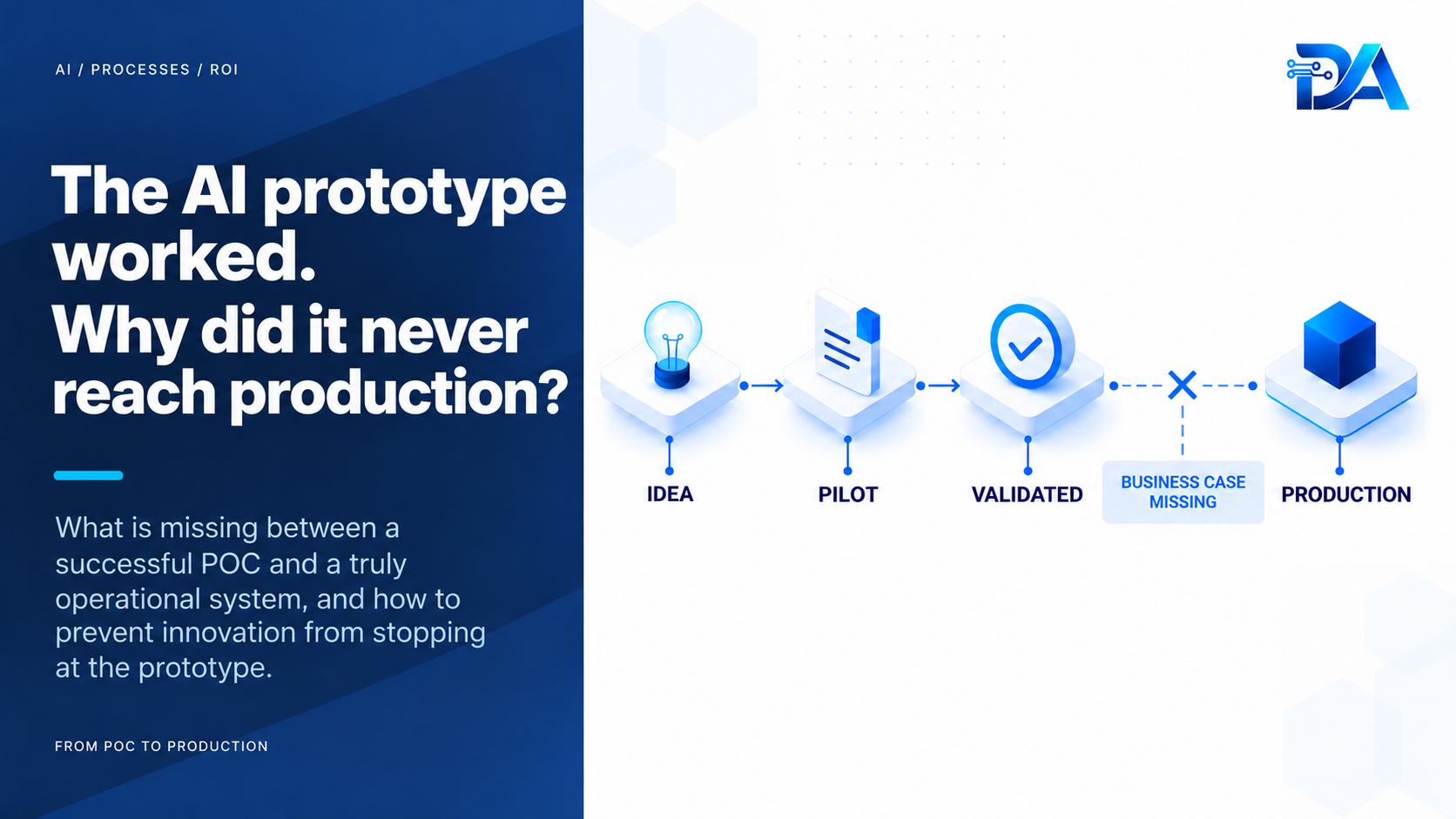
An AI proof of concept (POC), or pilot project, can meet every technical goal it was set and still never make it to production.
The model produces convincing results, the technical team delivers what was planned, and the final presentation wins management’s approval. Then comes the question that should have been asked before anyone started: is it worth investing to turn this into a system the business actually runs on?
At that point, the information needed to answer is often missing. Nobody measured what the current process costs, nobody estimated what it takes to run the system after release, and the business hasn’t decided who will own the outcome.
The POC succeeded, at least against the goals it was judged on. The next investment, however, has no convincing case behind it.
An AI integration project should tell you whether adopting AI pays off, with a real and measurable return.
That distinction changes how pilots are designed, funded and evaluated.
The problem isn’t experimenting. It’s not knowing what comes next
A POC makes sense when there is a real uncertainty to resolve. It might be the quality of customer service answers, the ability to handle heterogeneous documents, the cost of inference at higher volumes, or whether the solution can fit into day-to-day operations. If defining the problem has already pinned down the business processes and the data involved, integrating AI can be worthwhile and can scale.
Building AI-supported processes becomes a problem when it turns into a technology exercise, with no question the business is actually trying to answer.
McKinsey’s report The state of AI in 2026: On the road to ROI [1] finds that 44% of respondents say AI adoption in their organisation is expanding. Separately, 37% attribute at least some EBIT impact to AI.
McKinsey notes that the organisations getting the best results go through genuine transformation, with processes redesigned and reimagined. In other words, success with AI comes from reshaping operations around AI tools rather than bolting AI onto the processes that already exist. The question for decision-makers becomes: which operational and economic change needs rethinking to make it AI-native?
Before the POC: decide how you will measure ROI
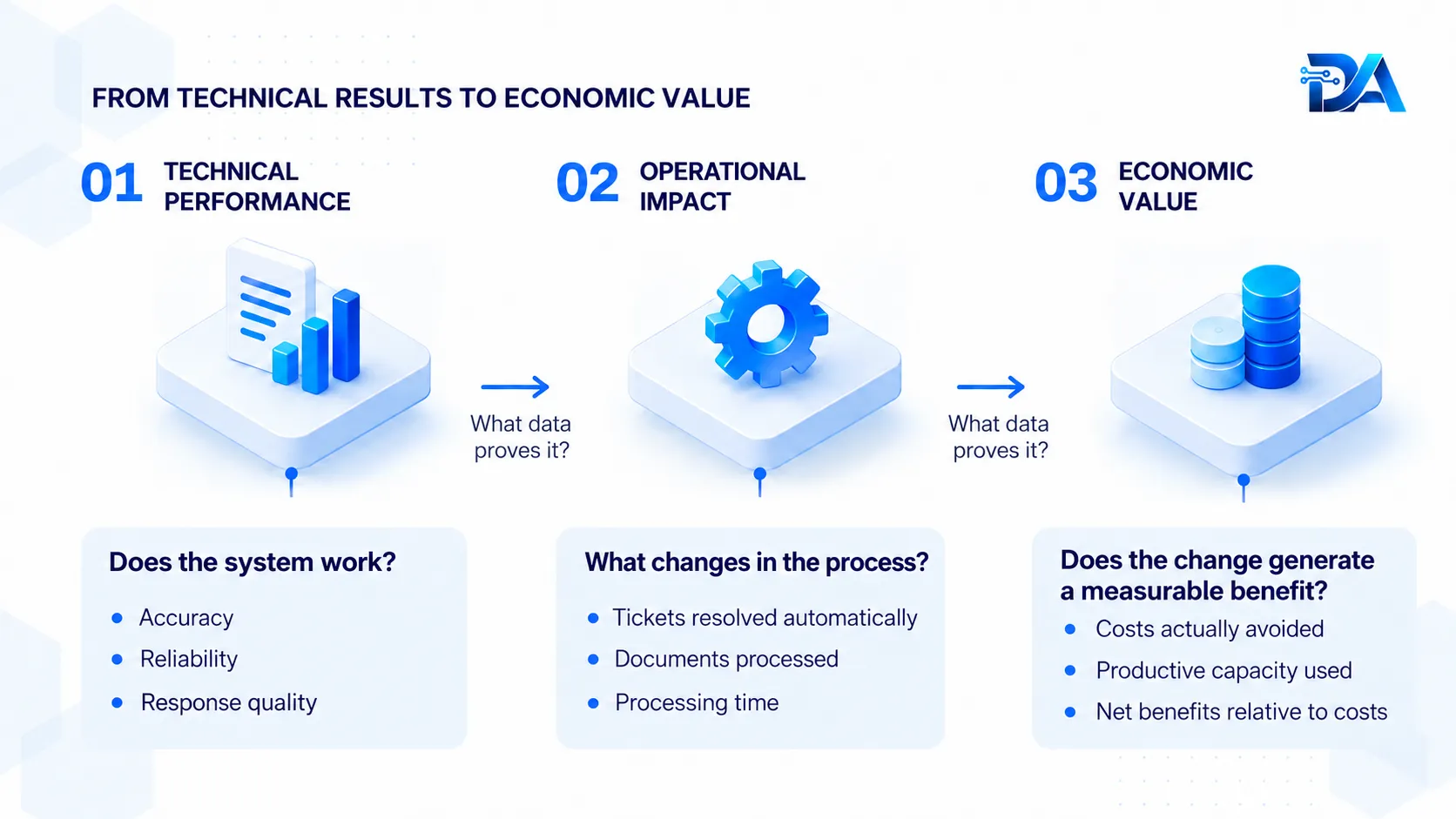
The ROI of artificial intelligence is not the same as a model’s accuracy or the number of tasks it automates. It requires an estimate of the economic benefits attributable to the project, weighed against its total cost over a defined period.
For an HR tech company, we built an AI agent connected to their existing knowledge base and CRM. After the first few weeks in production, about 30% of tickets were resolved without human intervention. Operators kept handling the cases that needed a person and supervised the automated answers to check their quality and any drift from the agreed standard.
In this case, the ROI assessment was operational. Alongside better metrics (response times, more consistent answers and a higher first-contact resolution rate), the long-term return was the chance to upskill the team: operators could focus on higher-value work such as upselling and technical specialisation. The full story is in the HR tech case study.
In pharma and regulatory work, one of our document automation systems processes more than 1,000 documents a month with no manual data extraction. That doesn’t mean removing every check: reviews, exceptions and supervision still need attention, but automation multiplies the team’s productivity.
These use cases show three distinct ways to read an integration:
- Technical performance. You can almost always measure how well the tool performs, using objective metrics.
- Operational impact. Higher productivity amplifies what each person, and therefore the team, can do.
- Economic value. The financial return shows how far AI actually cuts costs, avoids future costs or frees up capacity that is put to productive use.
Measuring this properly requires enough historical data.
The POC: decisions to make before you start
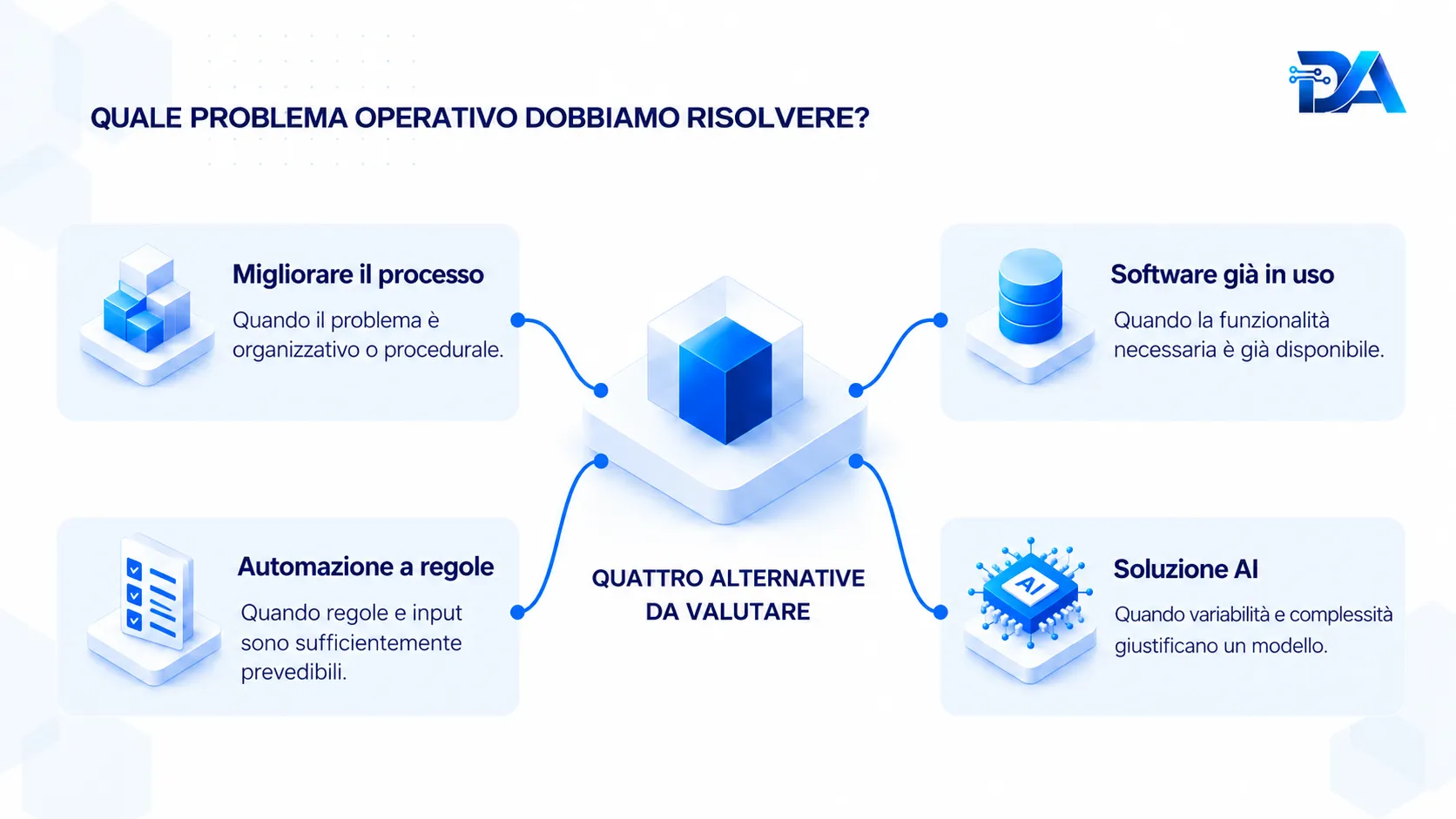
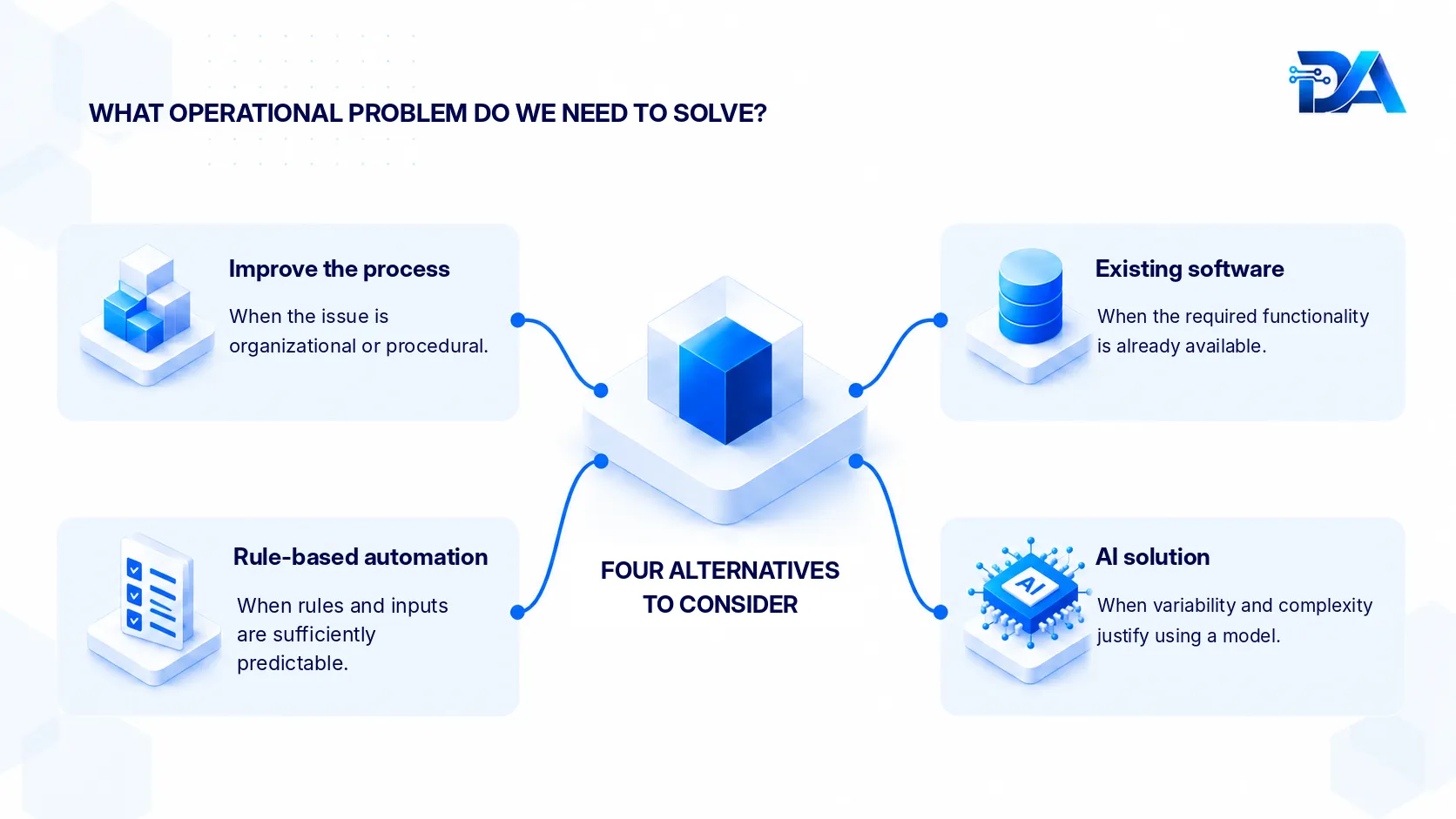
1. What is worth prototyping. Ask whether it makes sense to improve the current process, whether you could get more out of the software you already use, whether deterministic automation would do the job, or whether an AI solution is really needed. The answer depends on how variable the process is, the quality of the inputs, the integrations required and the cost of running it.
2. How to compare before and after. For this you need a baseline. Without one, you can measure how well the model works, but not how much it improves the process. Before the pilot, you need to know the volumes, times, costs and errors of the current work, at least for the part you plan to change. Above all, you need “reference” data to validate and benchmark whatever the AI produces.
3. Who owns the outcome. Identify and appoint an operational owner: someone who knows the process, brings users on board, evaluates the result and takes part in the investment decision. The Data Artisan Studio technical team takes responsibility for defining and delivering the technical solution, and we also support our partners through the decision-making and process transformation. But we can’t decide what a faster-handled request is worth to your business, or what error rate is acceptable. Those remain business decisions.
4. Whether the data and systems are ready. Check that representative data is available, that systems can be reached through APIs, and that the necessary permissions and authorisation constraints are in place. Errors and exceptions need testing too: when should the solution stop, who does the error get escalated to, and what information do they need to step in?
Finally, before you start, agree on a minimum quality threshold, a sustainable running cost, a manageable error rate, the integrations you can’t do without, and who will take over the service after release.
These criteria don’t all carry the same weight. Insufficient quality may mean revisiting the model, the architecture or the scope. A third-party integration that can’t be managed can make the whole system unusable. A cost per operation that is too high may make a feature of your existing software, or deterministic automation, the better choice.
The acceptable error rate deserves special attention. It depends on the process and on how risky the actions taken within it are: pre-classifying an incoming request doesn’t carry the same risk as an operation that affects payments or touches sensitive data.
Deciding not to move forward after a POC is a legitimate choice.
Knowing when to stop a project is part of being able to innovate
Continuing to fund a POC because the prototype works, or because you’ve already invested in it, is not a strategy.
In The Trap Behind AI Experimentation [2], published by INSEAD Knowledge in January 2026, Nathan Furr and Andrew Shipilov urge companies to tie AI experiments to real problems and to a concrete path to adoption.
Sometimes the most sensible choice is not to use AI at all. Our marketplace TrovaStorage, the Italian self-storage marketplace, was originally called Metroquadro. Before it became a marketplace, the tool used a deterministic algorithm to calculate the distance from an entry point to a self-storage unit.
The problem called for predictable, explainable results, not a probabilistic model, so we decided not to use AI. If you want to know more, we explain that choice in Our product doesn’t use AI. That was a decision, not an omission.
Even when a POC delivers encouraging results, for example by proving that something is technically possible, it may not show that this is the most useful or sustainable solution for the business. In that case it can make sense to stop, to take a different approach, or to rely more on automation.
At Data Artisan Studio, we don’t measure a POC’s success only by whether the next phase gets approved. Our goal is to give the business enough evidence to decide whether the investment makes sense, even when it doesn’t.
In our masterclass “From use case to ROI: AI projects that reach production”, we go deeper into how to set up this kind of assessment.
Evaluating a specific project? Book a 20-minute call.
References
- McKinsey & Company, The state of AI in 2026: On the road to ROI
- Nathan Furr, Andrew Shipilov, INSEAD Knowledge, The Trap Behind AI Experimentation, January 2026