

· Manfredi Miraula · Insights · 9 min read
The new SaS, Service-as-Software
Software helps manage the work, but it doesn't do it. What changes with Service-as-Software, where it creates value and when Artificial Intelligence is really needed.
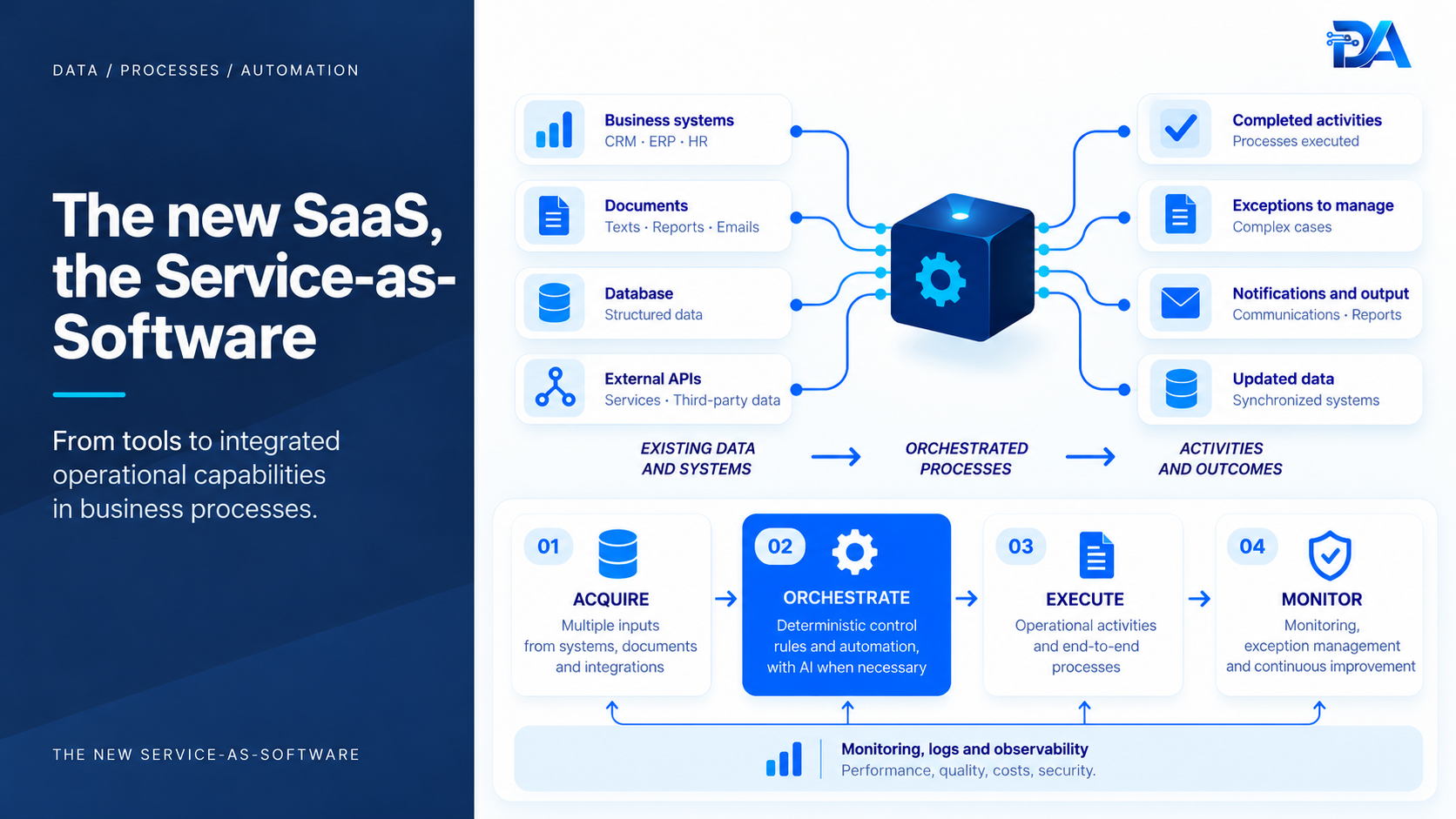
In recent years, the push of the SaaS movement has led companies to clutter themselves with more software than ever. CRMs, ERPs, document platforms, ticketing systems and collaboration tools have digitised a large share of business processes.
However, the growing number of internal tools has not always been followed by greater efficiency. Quite the opposite.
Many processes still depend on people who copy information, check documents, update systems and handle repetitive requests.
The problem? Software helps manage the work, but it doesn’t execute it under human supervision.
This is the bottleneck Service-as-Software is built on, an interesting model to explore when designing and buying business solutions.
Thanks to artificial intelligence and automation, some services traditionally performed by people can be increasingly supported by software systems integrated into business processes.
From SaaS to Service-as-Software: what really changes
The Software-as-a-Service (SaaS) model made business applications accessible through the cloud, usually by subscription. A company buys access to a platform and its employees use it to carry out their tasks.
Take a customer support system.
Ticketing software lets you collect requests, assign them to agents, monitor response times and browse the conversation history. It’s a useful tool, but the work largely stays in the hands of the team: someone has to read the ticket, look up the information, write a reply and solve the problem.
With Service-as-Software, the role of the system changes.
An AI agent connected to the company documentation and to the operational systems can interpret the request, retrieve the information it needs and autonomously resolve the cases that fall within its scope. When it runs into a complex situation or doesn’t have enough data, it can hand the request over to a specialised operator who, this way, adds their value where it’s needed, in the complex cases.
The goal of SaS is therefore not only to provide a tool, but an operational capability to resolve part of the work.
This doesn’t mean every application has to become autonomous, nor that traditional SaaS is bound to disappear. The two models can coexist, and it is often their integration that generates value.
A CRM remains the system of record for sales data. An automated service can use that data to complete certain tasks without requiring a salesperson to step in every time.
The change happens at the level of the operational process.
Where Service-as-Software can create value
The most interesting opportunities lie in high-volume processes, with repetitive tasks, scattered information and sufficiently clear operating rules.
These situations are common in structured companies, even when they already have an articulated software infrastructure. Below are a few case studies.
Customer support: from suggested replies to resolved tickets
Customer support is one of the areas where the shift is easiest to understand.
An AI assistant that suggests replies to agents improves the team’s work, but leaves the response rate unchanged, and in practice doesn’t help improve the team’s metrics.
An integrated AI agent, carefully developed and focused on specific categories, can directly and positively impact the team’s metrics, replying autonomously but with the company’s own tone of voice and drawing information directly from the company knowledge base.
Our team has already applied this approach successfully in a project for an HR Tech company, integrating an AI agent with the existing knowledge base and CRM. The system reached about 30% ticket deflection: almost one request in three is resolved without human intervention.
A word of caution: integrating this tool did not cut support costs by 30%, nor did it eliminate the need for agents. It means that a measurable share of the work is handled directly by the system, leaving the team the cases that need more attention and freeing up time to scale projects that can bring in new customers.
Document-heavy processes can be streamlined, from data extraction to case completion
Another classic example where SaS is easy to apply is document management.
In many organisations, receiving a document is only the start of the process: someone has to read it, identify the relevant information, check that it’s complete and transfer the data into the management systems.
In the pharmaceutical sector we built a document automation solution able to process over 1,000 documents a month, eliminating manual data extraction.
It’s a concrete result on one phase of the process. It doesn’t imply that every subsequent check has been eliminated. On the contrary, the role of quality control professionals is improved and sped up.
The next step, following the Service-as-Software logic, is to connect extraction to the execution of the tasks that follow: field validation, anomaly handling, system updates and routing of the cases to be reviewed.
The service no longer just produces structured data. It helps move forward the work that data is needed for.
Operations: processes that span multiple systems
Let’s consider a hypothetical example of B2B order management.
A customer sends an order by email, with a PDF attached. An operator reads the document, checks codes and availability in the ERP, verifies the commercial terms and records the order.
Part of the process could be executed automatically: document intake, data interpretation, matching against the product master data and preparation of the order in the management system.
Exceptions, such as an unknown code or an unexpected commercial term, would remain with authorised staff.
The value can be measured by the number of agentic tasks completed correctly.
The real work is behind the interface: integration, data and control

As we will never tire of saying, everything revolves around structure and data!
A demo can make building an AI service look simple: a request comes in, the system interprets it and produces an answer.
In production, things are different.
A business process rarely starts and ends in a single application. It has to interact with databases, ERPs, CRMs, document archives and authorisation systems. On top of that, data can be incomplete, processes may need to change and new cases not initially considered may appear.
It follows that we cannot reduce a Service-as-Software system to the mere integration of an AI agent, which is instead one of its components.
The success of this kind of project starts from a detailed architectural design:
- Data acquisition and centralisation are fundamental, as is proper integration through APIs.
- Define precisely which step of the process needs agentic autonomy, where the AI is left to act on its own. You need to balance the risk of error against the decision-making autonomy of an Artificial Intelligence.
- Every process has a certain degree of unpredictability. Analysing and controlling exceptions is essential for a system that stays stable over time. An exception that blocks the system or throws an unknown error is not as efficient as a system that asks the operator for support when something isn’t working properly.
- Monitoring and maintenance. You need to be able to reconstruct operations, identify failures, measure the quality of results and step in when data, models or processes change.
A sound design also means answering an important question that is often underestimated, or deliberately set aside: at which points does the system need Artificial Intelligence, and why?
Too often we force the integration of Artificial Intelligence into processes that are fundamentally deterministic, where data is organised in a structured way and the required output comes from a programmatic transformation or manipulation of the data.
In these cases, forcing Artificial Intelligence into a process only brings disorder to a system that would otherwise be simple and effective enough. Not to mention the potential extra costs that add no value.
The goal must be to maximise automation while keeping the operator’s control and supervision, without adding unnecessary components.
Service-as-Software shifts the cost from usage to outcome
The pricing model of a classic SaaS is pay-per-use. Usually a subscription based on service usage, the number of users and so on.
SaS changes the perspective, proposing a model that, in our view, is more advantageous and honest for the end user. The cost reflects the results.
A service that supports a customer service team can have a pricing model monetised on the reduction of incoming volume.
A document management service can be monetised on the number of documents processed and approved by the user.
This new commercial model can be more easily tied to the business process, so for a COO or a CFO the interesting point is having a more direct relationship between technology investment and operational capacity.
In our experience, the metrics to watch include:
- Share of actions completed without human intervention.
- Total completion time, including exceptions.
- Quality of results and frequency of corrections.
- Total cost per correctly completed action, including integrations, supervision and maintenance.
Every process is unique, and should be examined on its own, without applying a standard model that may not fit every situation.
How to tell if your company is ready for Service-as-Software

Our starting point, whenever possible, is always the functional analysis of a specific process. A few useful questions for a first internal assessment:
- How much manual work does the process require, and how many tools do you need to interact with?
- How much variability is there in the data, what exceptions can occur and what is the risk of an incorrect action being carried out?
- Are the tools needed to complete the process accessible and integrable with external tools? If the tools involved don’t provide APIs or adequate connection systems, integration becomes complex.
- What metrics is the system measured on? Is operator supervision needed only at the end, or also during automated processing and execution?
A set of questions like this makes it easy to identify whether integrating Artificial Intelligence is needed from the start, or whether it’s possible to define a deterministic automation service and add AI only later as further support.
Service-as-Software is not always the best answer. Sometimes SaaS is still the right answer, other times good old deterministic system design is the wisest choice!
At Data Artisan Studio we believe the future is integrated, simple and multi-functional technology
We believe the interesting idea behind Service-as-Software is not replacing human intervention, but the possibility of building systems that span entire business processes, supporting specialised operators who interact and supervise at an increasingly high level.
For companies, we believe SaS is initially a necessary evil to tackle, perhaps with our support. The success of these projects requires an initial effort in which processes are mapped and the people within them are positively involved.
The aim must be to reduce friction in execution without removing the supervision of domain experts, who will always have the sensitivity and experience needed to correct execution along the way, when necessary.
At Data Artisan Studio we have already helped many companies navigate transformative processes by integrating systems based on Artificial Intelligence and automation. Our proposals start from an initial exchange of knowledge, through our Masterclasses, and then grow into real partnerships in which we take care of building intelligent systems around your company’s needs.
Book a 20-minute call to discuss your operational context and see whether there’s a sensible project path.